
5 Fascinating Facts About Killer Whales and Their Secrets

Introduction
The name “killer whale” carries an intimidating weight, a legacy of ancient sailors who watched these black-and-white predators hunt much larger whales. Their scientific name, Orcinus orca, even echoes this reputation, with Orcinus translating to “of the kingdom of the dead”. However, much of what we think we know about these animals is colored by myth. Far from being mere monsters of the deep, orcas are highly intelligent, social, and culturally complex marine mammals that behave more like a sophisticated society than a simple predator.
The Great Identity Mystery
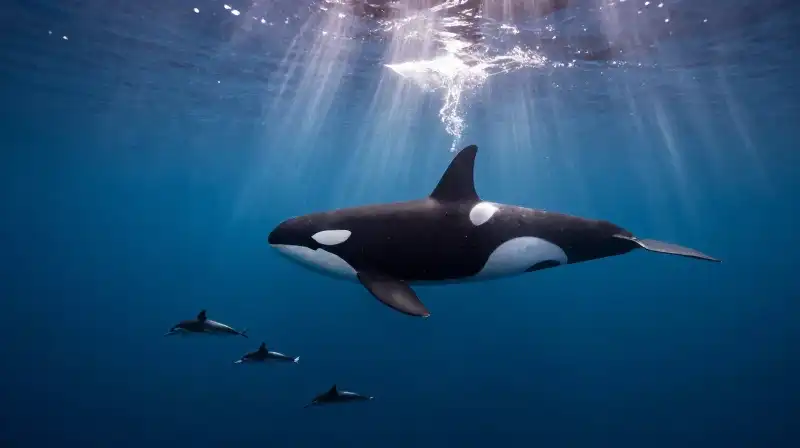
One of the most common misconceptions about these animals is their very classification. Despite their common name, orcas are not actually true whales; they are the largest species of the dolphin family. While they share the massive scale and predatory lifestyle often associated with whales, their biological lineage places them firmly within the Delphinidae family.
To understand the scale of these animals, it helps to look at their physical dimensions. While sizes can vary depending on the specific population, adult orcas are massive, typically averaging between 19 and 26 feet in length—roughly the size of a small school bus—and can weigh up to six tons.
| Feature | Orca Characteristics |
|---|---|
| Biological Family | Delphinidae (Dolphins) |
| Average Length | 19 to 26 feet |
| Maximum Weight | Up to 6 tons |
| Top Speed | Up to 30 knots / 34 mph |
5 Fascinating Facts About Killer Whales
Beyond their size and speed, the true complexity of the orca lies in their behavior and biological adaptations. Here are five key insights into their lives.
- They possess a rich, inherited culture. Orcas do not just rely on instinct; they rely on “culture.” This involves passing down unique vocalizations, distinct dialects, and specialized hunting techniques through generations. This means a pod in one part of the world may act and communicate entirely differently from a pod in another.
- They are highly specialized eaters. Orcas are apex predators with incredibly diverse diets, ranging from fish and seals to sharks and even large whales. Interestingly, certain groups, such as “offshore orcas,” are known to specifically hunt sharks. Once a family group learns a specific way of hunting a certain prey, they are unlikely to switch to another diet.
- They use advanced tactical hunting. These animals are master strategists. They have been observed using coordinated group tactics, such as intentionally creating waves to knock prey off ice floes or even beaching themselves momentarily to flush sea lions into the water.
- They sleep with one half of their brain at a time. To prevent drowning, orcas utilize a process called “unihemispheric sleep”. While one half of the brain rests, the other remains conscious to control breathing and monitor for danger. During this time, they will only close one eye at a time, alternating between hemispheres to ensure they never lose total consciousness.
- They are global citizens. Unlike many marine species that are restricted to specific latitudes, orcas have a wide global distribution. They can be found in every ocean on Earth, from the icy waters of the Arctic to the frigid reaches of Antarctica.
Lifespan and Longevity
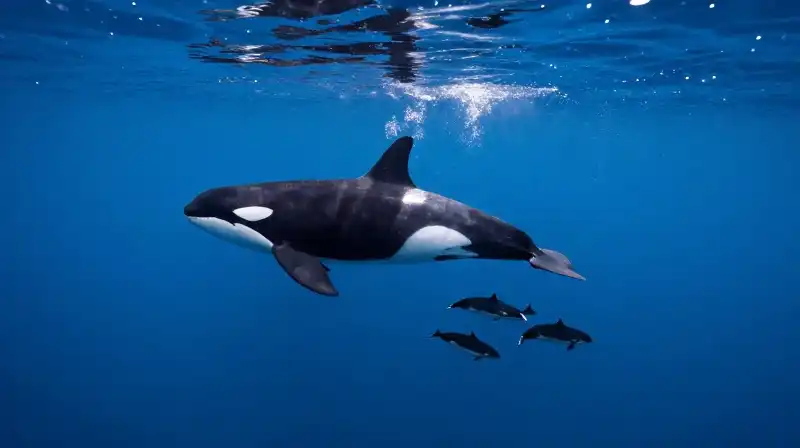
The life expectancy of an orca is heavily influenced by sex. On average, males live about 30 years, while females live longer, averaging around 50 years. Some matriarchs—the female leaders of the pod—have been estimated to live between 60 and 80 years.
Can killer whales live 100 years? While there is no definitive scientific evidence in the current research to confirm that orcas can reach a century of age, their longevity is impressive for a marine mammal, particularly for females who lead their social groups for many decades.
Their reproductive cycle is also notably long. Orcas have an exceptionally long gestation period compared to many other mammals, with pregnancies lasting between 15 and 18 months.
Why the Orca Matters
Understanding the orca requires looking past the “killer” label to see a creature of immense intelligence and social sophistication. They are not just predators; they are students of their environment, passing down knowledge through generations to survive in every corner of the globe. Their specialized diets, unique sleep patterns, and complex cultures make them one of the most remarkable examples of evolutionary adaptation in the marine world.
Facts sourced from peer-reviewed marine biology research, NOAA, and the Smithsonian Ocean Portal. Our editorial team fact-checks all content against current scientific literature.
Frequently Asked Questions
Can killer whales live 100 years?
There is no definitive scientific evidence in current research to confirm that killer whales can reach a century of age. On average, males live about 30 years and females average around 50 years, though some female matriarchs are estimated to live between 60 and 80 years.
Related Articles