Thresher Shark Facts: Tail Weapons, Hunting and Behavior

Introduction
Most sharks rely on powerful jaws and serrated teeth to secure a meal, but the thresher shark has developed a much more unconventional approach to hunting. Equipped with an extraordinary, whip-like tail that can account for nearly half of its total body length, this predator uses its caudal fin as a specialized biological weapon. Rather than simply biting, the thresher shark lashes its tail through the water to create powerful shock waves, stunning or herding schools of fish into a concentrated group for an easy catch.
Meet the Thresher Sharks

Within the family Alopiidae, there are three recognized living species. While they all share the characteristic long tail, they differ significantly in terms of their size, where they live, and their specific physical traits.
| Species | Typical Size | Primary Habitat |
|---|---|---|
| Common Thresher | Up to 19 feet | Worldwide oceans |
| Bigeye Thresher | Varies | Worldwide oceans |
| Pelagic Thresher | Approximately 3 feet | Indian and Pacific Oceans |
Beyond size differences, some species possess unique sensory adaptations. For example, the bigeye thresher has eyes that wrap onto the dorsal surface of its head, a structural feature that allows it to scan the water directly above it.
Thresher Shark Facts: Specialized Hunting and Biology
The thresher shark is a highly evolved predator designed for efficiency in the open ocean. Several biological adaptations allow it to thrive in environments that would be difficult for other sharks.
- High-Speed Pursuit: Thanks to their streamlined, torpedo-shaped bodies, thresher sharks are remarkably fast. They can reach speeds of up to 22 mph, which is faster than the average speed of a great white shark.
- Regional Endothermy: These sharks utilize a unique adaptation called “regional endothermy.” This allows them to maintain body temperatures warmer than the surrounding water in specific parts of their bodies, giving them a metabolic advantage when hunting in cooler, deeper environments.
- Extreme Depth Regulation: While they are primarily pelagic dwellers, thresher sharks are capable of navigating immense vertical ranges. They are typically found around 550 meters, but they have been recorded at depths reaching as much as 1,500 meters.
- Life Cycle Transitions: Although adults prefer the deep, open ocean, they move to coastal waters to breed. Juveniles tend to stay in shallower areas for protection before eventually migrating to the deep sea as they mature.
Why do thresher sharks jump?
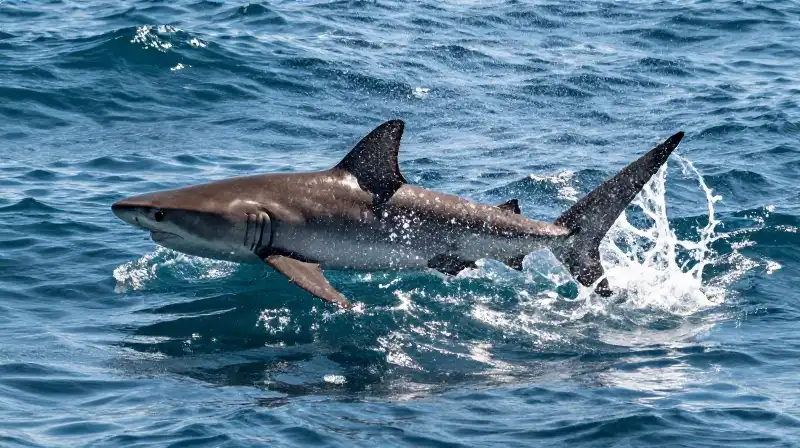
One of the most striking sights for marine biologists and divers is the thresher shark breaching—leaping partially or entirely out of the water. Some individuals have been observed using their powerful tails to propel themselves up to three meters high.
Researchers are still investigating the exact purpose behind this spectacular behavior. Current theories suggest it could serve several functions, such as:
- Communication: Using the splash or movement to signal to other sharks.
- Parasite Removal: Striking the surface to dislodge external parasites.
- Other unknown biological drivers: Scientists continue to study whether this is a social or purely physiological necessity.
Conservation and Viewing Opportunities
Despite their predatory prowess, thresher sharks face significant survival challenges. They are vulnerable to overfishing and accidental capture as bycatch. Their ability to recover from population declines is hampered by their naturally slow reproductive rates.
For those interested in observing these animals in their natural habitat, certain “hotspots” are known for frequent sightings. Notable locations for divers include the Monad Shoal off Malapascua Island in the Philippines and the Fuvahmulah Atoll in the Maldives.
Summary of the Thresher’s Unique Edge
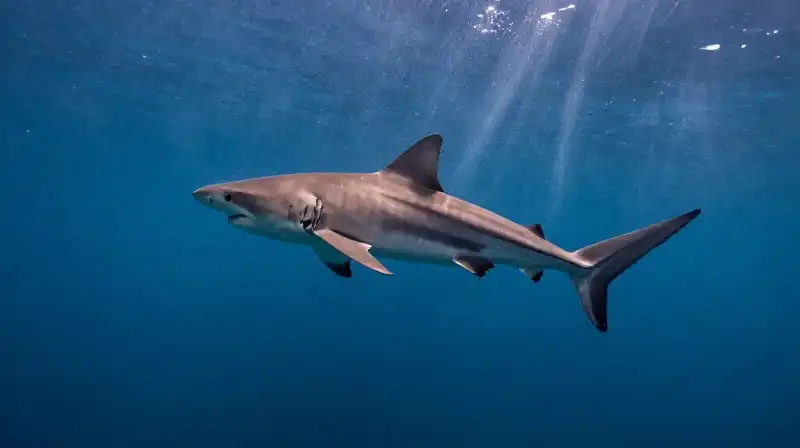
The thresher shark stands out in the marine world not just for its size, but for its specialized evolution. From its ability to “weaponize” its own anatomy to its sophisticated temperature regulation, every aspect of its biology is geared toward high-efficiency hunting in the vast, often cold, expanse of the open ocean. Understanding these sharks requires looking past the “scary predator” trope and recognizing a highly specialized animal that has mastered a unique niche in the deep sea.
Facts sourced from peer-reviewed marine biology research, NOAA, and the Smithsonian Ocean Portal. Our editorial team fact-checks all content against current scientific literature.
Frequently Asked Questions
How high do thresher sharks jump?
Some individual thresher sharks have been observed using their powerful tails to propel themselves up to three meters high.
Why do thresher sharks jump?
Researchers are still investigating the exact purpose of this behavior, but current theories suggest it could be for communication or for dislodging external parasites.
Related Articles