
Creepy Facts About the Ocean: The Terrifying Mysteries of the Deep

Introduction
The ocean is a world of extremes, where the physics of the surface gives way to environments that feel fundamentally alien. While we often view the sea through the lens of sunlit reefs and tropical beaches, the reality of the blue planet is dominated by vast, crushing voids and environments that defy human biology. Much of what we consider “the ocean” is actually a massive, interconnected system of darkness and high pressure that remains largely unmapped and misunderstood.
The Mystery of the Unseen Deep
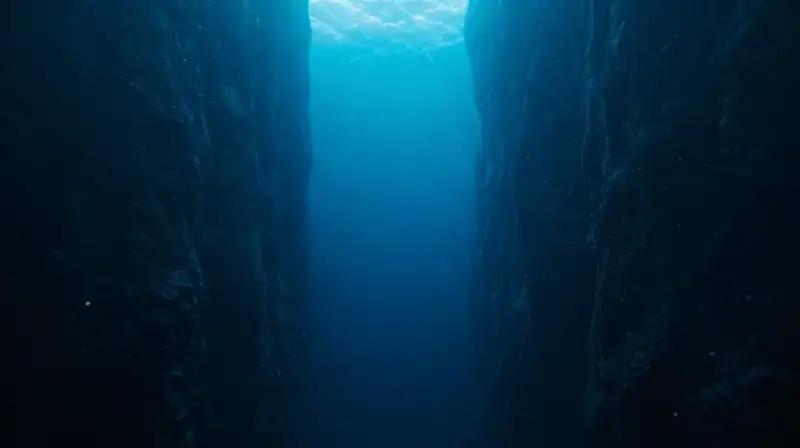
Despite our technological advancements, we are still largely strangers to our own planet. Current research suggests that humans have explored only between 5% and 20% of the ocean, leaving the vast majority of the deep sea a complete mystery. This lack of exploration is due to several daunting physical barriers that make the deep sea one of the most difficult places on Earth to study.
- Perpetual Darkness: Sunlight is a finite resource in the water column. It cannot penetrate deeper than a surface layer of approximately 600 feet, meaning the vast majority of marine life lives in total, absolute darkness.
- Crushing Pressure: In the deepest parts of the ocean, the weight of the water above is staggering. At the bottom of the Challenger Deep—the deepest known point in the Mariana Trench, reaching roughly 36,200 feet—the water pressure is approximately 1,100 times the air pressure humans are accustomed to.
- Extreme Temperatures: While much of the deep sea is near freezing, certain areas are incredibly volatile. Hydrothermal vents, located where tectonic plates spread, can release seawater heated by magma to temperatures as high as 700 degrees Fahrenheit.
Strange Biology and Bizarre Behaviors
Survival in these extreme conditions has forced marine life to evolve in ways that seem unsettling to those used to terrestrial biology. From specialized hunting tactics to unusual physiological traits, the inhabitants of the deep are masters of adaptation.
The White Shark Café and Apex Predators
Even in the relatively well-studied upper layers of the ocean, patterns emerge that baffle scientists. In the remote Pacific region known as the “White Shark Café,” located between Hawaii and the Baja California peninsula, large numbers of great white sharks congregate annually. Scientists are still investigating the exact reason for this gathering, though theories suggest it may be for mating or specific foraging opportunities.
Great white sharks also utilize specialized hunting strategies that demonstrate their role as apex predators. Rather than chasing prey from behind, they often hunt by dropping low in the water column. They scan for the distinct shadows of seals or other prey against the surface light before accelerating rapidly upward in a high-speed strike.
The Oddities of the Deep-Sea Ecosystem
Beyond the famous predators, the deep sea is home to creatures that challenge our understanding of vertebrate biology and energy consumption.
- The Bony-Eared Assfish: This species is notable for its extreme biological efficiency, possessing the smallest brain-to-body weight ratio among all known vertebrates.
- Marine Snow: Because photosynthesis is impossible in the deep, many ecosystems rely on “marine snow.” This consists of organic material—detritus, dead organisms, and waste—that drifts down from the productive surface layers to feed the creatures below.
- Microscopic Giants: The sheer scale of life is also evident at the microscopic level. A single milliliter of ocean water can contain an estimated 10 million viruses, the majority of which infect bacteria and phytoplankton.
Human Peril and the Unknown
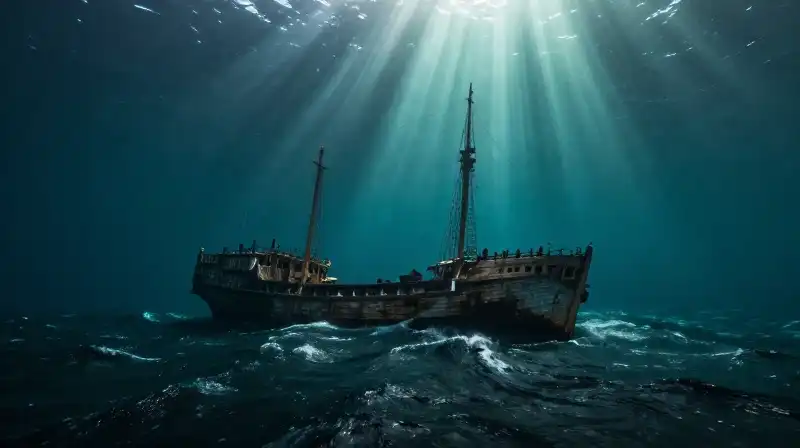
The ocean’s capacity to isolate and overwhelm humans is a recurring theme in maritime history. The environment itself can be as dangerous as any predator.
In extreme survival scenarios, such as being submerged in salt water for more than three days, the physiological effects on a human are severe; the skin can actually begin to dissolve. This physical toll is compounded by the ocean’s tendency to swallow history. “Ghost ships”—vessels found adrift and intact with no sign of their crew—are a documented occurrence, such as the case of a Taiwanese fishing vessel found in 2021.
Common Questions About the Ocean
What did NASA find in the sea?
While there are many popular theories and internet rumors regarding “NASA finds” in the ocean, scientific exploration by space agencies typically focuses on using satellite technology to monitor ocean health, sea levels, and temperature changes. There is no documented scientific evidence of NASA discovering extraterrestrial life or anomalous structures within the deep sea; rather, their contribution is providing the data necessary to understand our planet’s changing climate and oceanic patterns.
The Scale of the Unknown
The “scary” or “creepy” aspects of the ocean are often just reflections of how much we have yet to learn. The combination of extreme pressure, total darkness, and the sheer vastness of unexplored territory creates a sense of the unknown that is difficult to replicate anywhere else on Earth. Understanding these environments—from the microscopic viruses to the massive migrations of great white sharks—is not just about satisfying curiosity; it is essential for marine biology and the conservation of a planet that is still, in many ways, a frontier.
Facts sourced from peer-reviewed marine biology research, NOAA, and the Smithsonian Ocean Portal. Our editorial team fact-checks all content against current scientific literature.
Frequently Asked Questions
What did NASA find in the sea?
There is no documented scientific evidence of NASA discovering extraterrestrial life or anomalous structures in the sea. Instead, NASA uses satellite technology to monitor ocean health, sea levels, and temperature changes.
Related Articles