
10 Fascinating Facts About Seahorses and Their Unique Lives

Introduction
While their name is derived from the Latin Hippocampus, meaning “horse animal,” seahorses are far more than just whimsical ocean decorations. Though they look like something out of a fantasy novel, they are true fish, equipped with gills to breathe and a swim bladder to manage their buoyancy. These tiny, specialized creatures have traded the typical streamlined shape of most fish for a body built for precision and patience rather than speed. From their unique reproductive roles to their incredible ability to mimic their surroundings, seahorses represent one of the most distinct evolutionary paths in the marine world.
10 Fascinating Facts About Seahorses
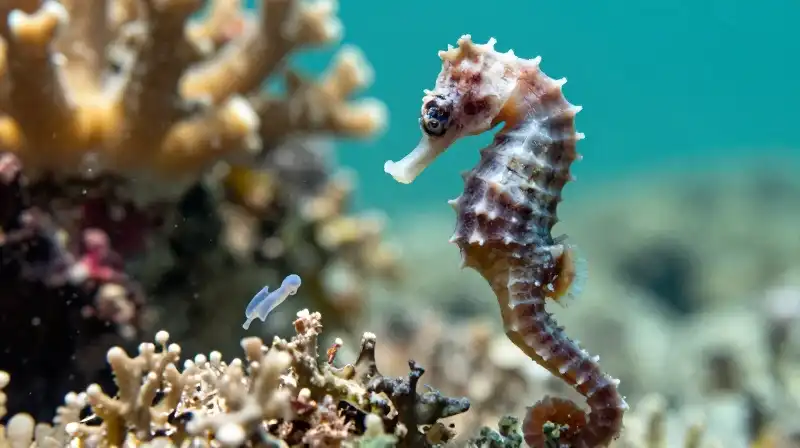
To understand why these animals are so highly regarded by marine biologists, we have to look past their strange appearance and examine how they survive in a competitive ocean environment.
- The male carries the young: One of the most famous misconceptions about seahorses is that the males give birth. In reality, the female deposits her eggs into a specialized brood pouch located on the male’s abdomen. The male then carries these eggs until they hatch, a role that is physically intensive; he can carry up to 2,000 “fry” at once, and the process of expelling them can involve contractions lasting up to 12 hours.
- They are master ambush predators: Seahorses are not active hunters that chase down prey. Instead, they use their long, tube-like snouts to act like a vacuum cleaner, sucking in tiny crustaceans, brine shrimp, and plankton with incredible speed.
- They must eat almost constantly: Because seahorses lack both teeth and a stomach, food passes through their digestive systems incredibly quickly. To compensate for this, they may need to consume as many as 3,000 small crustaceans every single day just to stay nourished.
- They possess “fingerprint” markings: Just as humans are identified by unique fingerprints, every individual seahorse has its own distinct markings. This includes the specific, unique pattern of the “coral net”—the spiky crown found on their heads.
- Their eyes work independently: A seahorse can scan its environment with dual-focus vision. Their eyes can work independently of one another, allowing them to look forward and backward simultaneously to watch for predators while searching for food.
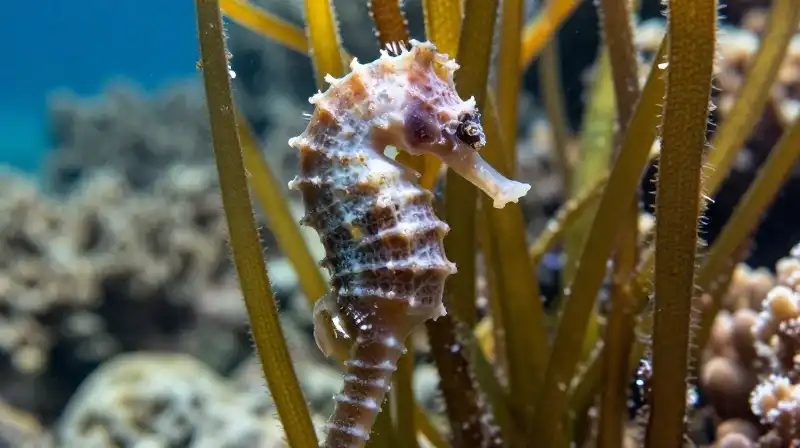
- They use a prehensile tail for stability: To prevent being swept away by ocean currents, seahorses use their tails like a fifth limb. This prehensile tail allows them to anchor themselves firmly to seagrass or coral, helping them remain still while they hunt.
- They are masters of camouflage: Survival often depends on being invisible. Seahorses can rapidly change their colors and even protrude or retract spiny growths to blend perfectly into their reef habitats.
- They have an exoskeleton: Instead of being covered in traditional scales, a seahorse’s body is protected by an exoskeleton made of hard, bony plates covered by a thin layer of skin.
- They engage in elaborate courtship: Many seahorse species are monogamous, staying with a single partner for an entire mating season or even for life. Before mating, they often perform hour-long courtship dances where they intertwine their tails and change colors in unison.
- They are among the slowest swimmers: Due to their upright body shape, seahorses are considered poor swimmers. They rely on a small dorsal fin on their back for forward motion and tiny pectoral fins on their heads for maneuvering. The dwarf seahorse is particularly notable, being one of the slowest fish in the world with a travel speed of only about five feet per hour.
Comparing Movement and Anatomy
While most fish rely on powerful tails to propel themselves through the water, the seahorse’s anatomy is geared toward stability and stealth.
| Feature | Typical Fish | Seahorse |
|---|---|---|
| Primary Movement | Side-to-side tail undulation | Dorsal fin (back) for propulsion |
| Steering | Pectoral and pelvic fins | Small pectoral fins on the head |
| Body Covering | Scales | Bony plates (exoskeleton) |
| Feeding Method | Biting, suction, or filtering | High-speed vacuum suction via snout |
Threats and Conservation Status
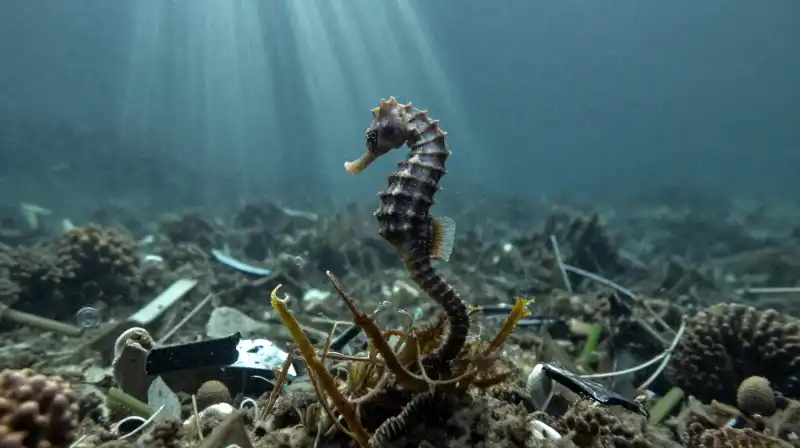
Despite their ability to camouflage and hide, seahorses face mounting pressures from human activity. Their survival is closely tied to the health of seagrass beds and coral reefs.
Significant threats include habitat loss, climate change, and bycatch from non-selective fishing. Furthermore, they are often targeted specifically for use in traditional medicines or as souvenirs. Because of these pressures, their conservation status varies significantly depending on the species; while some are categorized as “Vulnerable,” others are currently listed as “Data Deficient,” meaning we do not yet have enough scientific information to determine their true risk of extinction.
Why the Seahorse Matters
The seahorse is a testament to the incredible diversity of marine life. They challenge our standard definitions of “fish” through their unique reproductive cycles, their armored bodies, and their specialized way of interacting with the seafloor. Protecting these small, slow-moving creatures is about more than just saving a single species—it is about preserving the complex, delicate ecosystems like coral reefs and seagrass meadows that allow such specialized life to thrive.
Facts sourced from peer-reviewed marine biology research, NOAA, and the Smithsonian Ocean Portal. Our editorial team fact-checks all content against current scientific literature.
Related Articles