12 Fascinating Facts About Sharks and Their Biology


Introduction
While cinema often portrays sharks as mindless hunters, the reality of their biology is far more sophisticated. These ancient predators are marvels of evolutionary engineering, possessing sensory systems and physical adaptations that allow them to thrive in environments ranging from sunlit coral reefs to the crushing darkness of the deep sea. To understand a shark is to understand a creature that has mastered the art of sensing the invisible and moving through water with unparalleled efficiency.
The Biological Foundations of Sharks

A common misconception is that sharks are built like typical bony fish. In truth, they belong to a group known as elasmobranchs, which means their skeletons are composed of cartilage rather than bone. This is the same flexible, gristly tissue found in human ears and noses. This lightweight framework provides a significant advantage, offering more buoyancy and flexibility than a heavy bony skeleton.
Despite this lack of true bone, sharks leave a lasting legacy in the fossil record. As they age, they deposit calcium salts into their cartilaginous skeletons, allowing parts of them to fossilize. Furthermore, their teeth are incredibly durable, containing enamel that allows them to persist long after the animal has passed.
Sensory Superpowers: Beyond Sight and Smell
Sharks do not just see and smell the ocean; they feel it through complex biological sensors. Their ability to navigate and hunt is driven by several specialized adaptations:
- Electroreception: Near their eyes, nose, and mouth, sharks possess specialized organs called the ampullae of Lorenzini. These allow them to detect minute electromagnetic fields and temperature shifts in the water, helping them locate prey even when it is buried in sand or hidden in darkness.
- Advanced Vision: Most sharks possess excellent eyesight, including the ability to see color. To aid in low-light hunting, many species have a reflective layer of tissue in the eye called the tapetum, which significantly enhances their night vision.
- Skin Texture: If you were to touch a shark, it would feel like sandpaper. This is due to dermal denticles—tiny, tooth-like scales that point toward the tail. These structures are designed to reduce water friction, allowing the shark to swim more efficiently.
Diversity in Form and Function
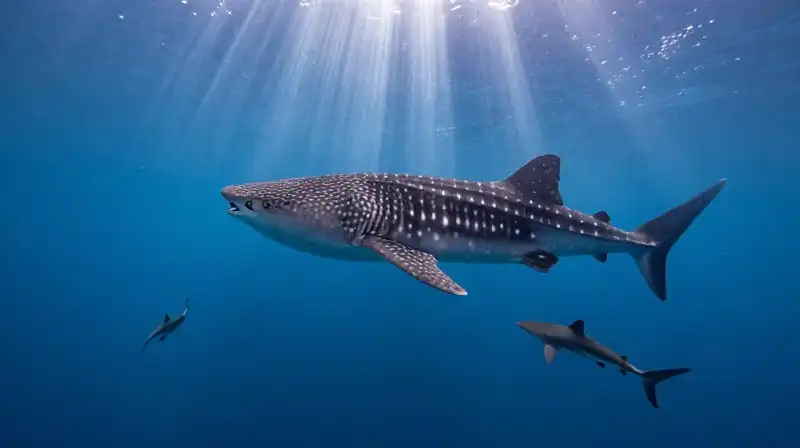
There is no single “shark type.” From the giants of the open ocean to small, bottom-dwelling specialists, their anatomy is finely tuned to their specific ecological niches.
Size and Scale
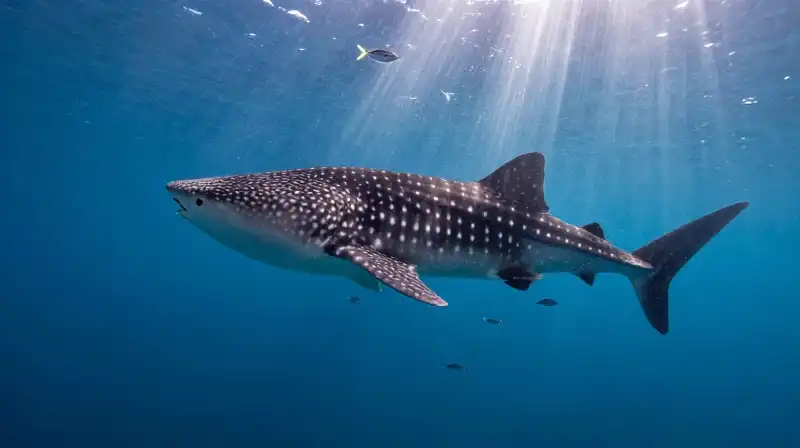
The scale of shark species can vary wildly. For instance, the whale shark holds the title of the largest fish in the ocean, with some estimates suggesting they can reach lengths of 12.2 meters and weigh as much as 40 tons.
Specialized Teeth and Diet
A shark’s teeth are a primary indicator of its hunting style. Rather than a “one size fits all” approach, their dentition is specialized for their prey:
| Shark Type | Tooth Characteristic | Likely Function |
|---|---|---|
| Mako Shark | Pointed teeth | Piercing and grasping fast-moving prey |
| Great White Shark | Triangular, serrated teeth | Slicing through larger, tougher prey |
Reproductive Strategies
Shark reproduction is remarkably diverse. Some species are oviparous, meaning they lay eggs that hatch outside the mother’s body, while others are viviparous, giving birth to live young. This variety ensures that different species can succeed in vastly different marine habitats.
Unexpected Shark Behaviors
Beyond hunting and swimming, sharks exhibit biological behaviors that can seem almost otherworldly to human observers.
Tonic Immobility: If a shark is flipped upside down, it may enter a trance-like state known as tonic immobility. While it may look like sleep, it is a physiological response to the physical position of the animal.
Specialized Breathing: While many sharks must swim constantly to move water over their gills, some species like nurse sharks and angel sharks can rest on the seafloor. They utilize an organ called a spiracle, located behind the eyes, which acts as a pump to move water directly to their gills.
How Do We Study Them?

Determining the age of a shark is a complex scientific task. Much like counting the rings of a tree, researchers attempt to age sharks by counting concentric bands on their vertebrae. However, this is not an exact science; the rate at which these bands are deposited can change based on the shark’s size and its specific species. Because of this variability, scientists must use a process called “validation” to ensure their age estimates are accurate.
The Importance of Shark Biology
From the brilliant blue hue of the blue shark to the massive, filter-feeding whale shark, these animals represent a massive spectrum of biological success. They are not merely “predators,” but vital components of the ocean’s health. Understanding their unique anatomy—from their sandpaper-like skin to their electromagnetic sensors—helps us appreciate the complexity of the marine ecosystems they help maintain. By recognizing sharks as highly specialized survivors rather than monsters, we gain a better perspective on the importance of marine conservation and the preservation of the deep sea.
Facts sourced from peer-reviewed marine biology research, NOAA, and the Smithsonian Ocean Portal. Our editorial team fact-checks all content against current scientific literature.
Related Articles